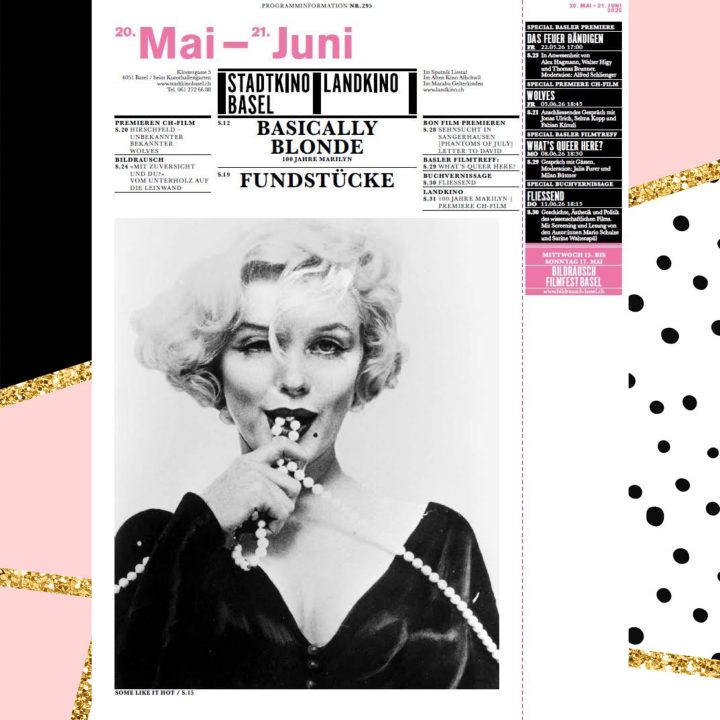
Basically Blonde: 100 Years of Marilyn – a retrospective with a difference – opens at Stadtkino Basel in Switzerland on Wednesday, May 20.
“Is blonde really just a hair colour? Since the early days of Hollywood, being blonde has served as a projection screen for fantasies, desires, and power. Hardly any figure embodies this more clearly than Marilyn Monroe, whose 100th birthday on June 1st is the occasion for this film series. ‘Basically Blonde: 100 Years of Marilyn’ explores the images and their meanings: Representational conventions, ideals of beauty, and regimes of gaze become visible – as do their ironic subversions. The focus is on the pleasurable participation in the performance of cinematic illusion, in sensual appearances, and in the ongoing negotiation of constantly shifting codes. The series takes viewers on a journey through film history; from absurdist pre-war comedies to Hollywood musicals and film noir, to European auteur cinema and contemporary chapters on blondes.”
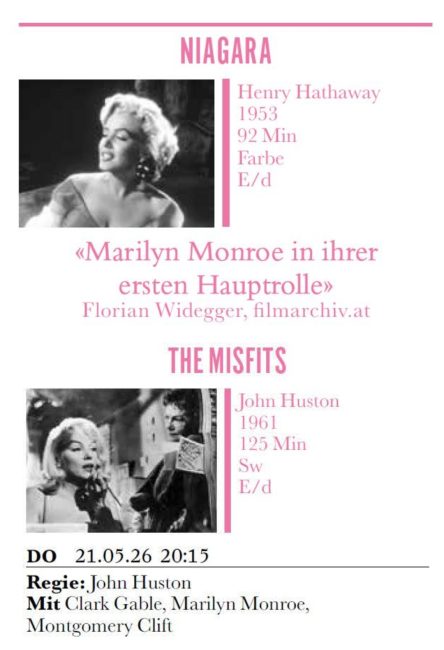
- NIAGARA: May 20; May 30; June 14
- GENTLEMEN PREFER BLONDES: May 23; June 10; June 21
- SOME LIKE IT HOT: May 24; June 5; June 17
- THE SEVEN YEAR ITCH: May 27; June 13
- THE MISFITS: June 3: June 7; June 20
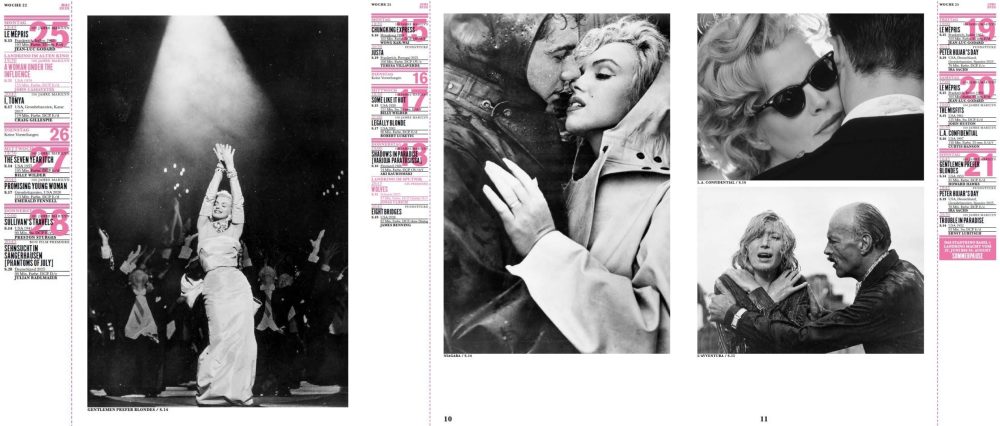
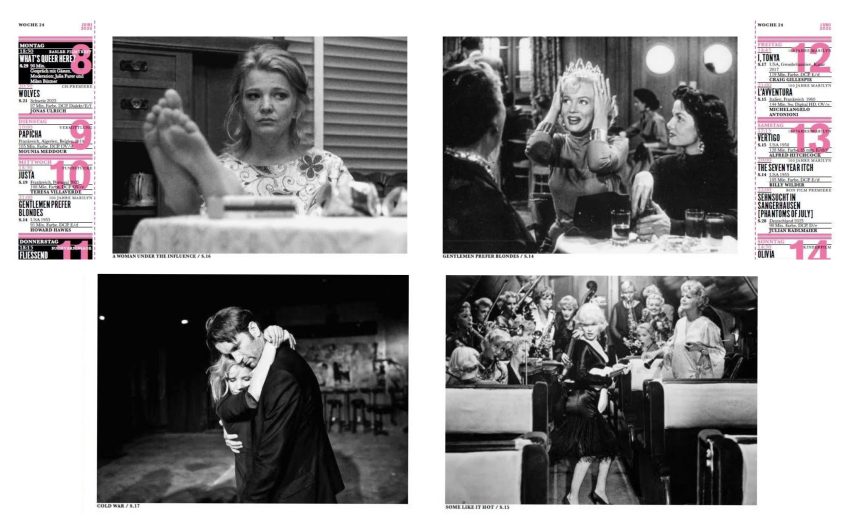
As well as the five Monroe films, the programme features other notable cinematic blondes, including those who preceded Marilyn: Miriam Hopkins in Trouble in Paradise (1932), and Veronica Lake in Sullivan’s Travels (1941); her peers: Kim Novak in Vertigo (1957), Monica Vitti in L’Avventura (1960), Brigitte Bardot in Le Mepris aka Contempt (1963), and Gena Rowlands in A Woman Under the Influence (1974); and those who followed: Kati Outinen in Shadows in Paradise (1986), Brigitte Lin in Chungking Express (1994), Kim Basinger in L.A. Confidential (1997), Reese Witherspoon in Legally Blonde (2001), Margot Robbie in I, Tonya (2017), Joanna Kulig in Cold War (2018), and Carey Mulligan in Promising Young Woman (2020.)
 Franziska Heller has written an essay for this retrospective, Basically Blonde: Years of Marilyn – Cinema and the Afterimages.
“However one situates the reasons within cultural history, the connection between women, light hair, and heightened, if not maximal, physicality and attractiveness is ubiquitous—a link that culminates in a comprehensive fetishisation … No other medium has so literally illustrated these debates, both in its own historiography and narratives, as in its most powerful form of expression—audiovisual images. Countless times, (Hollywood) cinema has been critically examined as a testament to sociocultural contexts.
The most well-known concept relates directly to its specifically visual forms, their inherent ideological power structures, and the potential of sexually charged projection: the (male) gaze …. Marilyn Monroe, as a multifaceted mediated persona within the historical star system, occupies a key position—as the ‘ultimate signifier of sexuality.’ When Laura Mulvey, as recently as 2019, traces the ‘lasting images’—’afterimages’—of cinema and women in changing times as psychosocial symptoms in the sense of Freudian ‘belatedness,’ she is engaging with Monroe in film history beyond the content of the films themselves.
She compares Monroe, as a timeless super-sign for Hollywood, to the similarly easily recognisable star persona of Charlie Chaplin. Only Chaplin and Monroe are still identifiable today with a few attributes; however, Chaplin is usually shown with his whole body and his props (dressed with hat and cane), while Marilyn is frequently depicted in a close-up focusing on her lasciviously parted lips and framing blonde hair—or in the pose exposing her lower body from Billy Wilder’s The Seven Year Itch (1955), with her skirt billowing up on a subway grate.
These differences in visual memory reflect the divergent assessments of their historical positions within the Hollywood system. Chaplin, with his accumulated power, is celebrated as a self-determined, creative, auteur-like performer, producer, and director, while Monroe—even in the constant interweaving of (re)tellings of her biography—is always accompanied by an image of insecurity. Her dependence on mentors is a recurring narrative. These are tendencies that even more recent biopics play with, not least Blonde from 2022, which Die Zeit acknowledges as having ‘visual power’, but at the same time describes as ‘intrusive’ in its engaging aesthetic of overwhelming a woman who lives in a nightmare and ‘belongs to everyone’.
The central role of colour in film is immediately apparent – quite literally. The Technicolor film Niagara (1953) offers a spectacle of mystery, color film technology, and visual splendour, where both Monroe and the waterfalls unfold their full force in the overwhelming display of colour. Nevertheless, the series also includes works that celebrate the fascination of playing with illusionary images in monochrome … The ambiguities already present in the Monroe showgirl films and (disguise) comedies of the 1950s, with their affirmation of fetishization and ironic refractions within the excesses of cinematic spectacle, are further fractured in The Misfits (1961) through reconfiguration.
This recontextualization involves reframing the diverse media images of Monroe—star photos on a wardrobe door that is immediately closed. In Arthur Miller’s story, Monroe appears deliberately more naturalistic and fractured; the first glimpses of her are through a mirror image.”
 The Marilyn Report