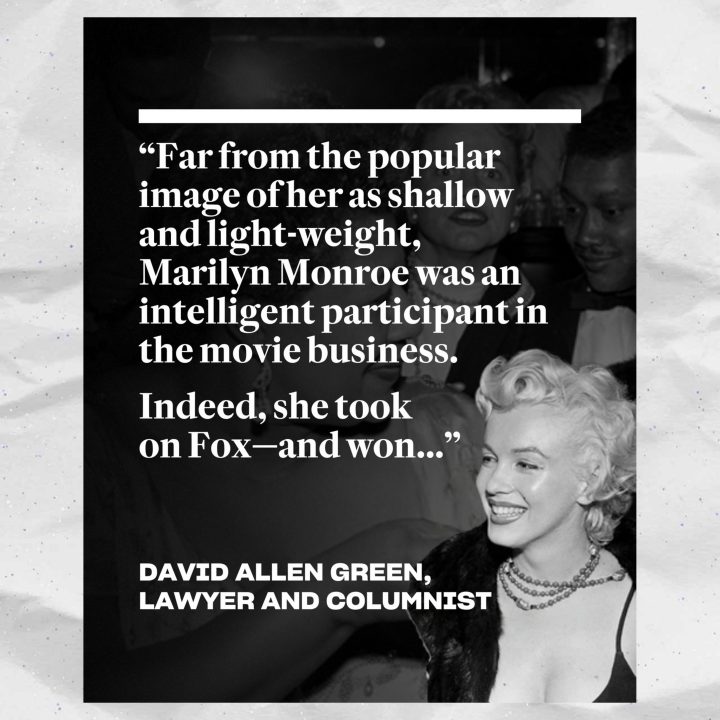
In the July edition of UK news monthly Prospect, David Allen Green offers a lawyer’s perspective on Marilyn’s legal battle with Twentieth Century-Fox. (A longer version of the article is available at Green’s blog, The Empty City.)
Marilyn Monroe, the Hollywood studio system, and the law of contract
“Monroe had a contract with Twentieth Century Fox. Ironically, given the title of one of her best films, it was a seven year service contract … Sometimes when an unknown enters a long-term contract with a media company (like a studio or a record label), there is a sense of a trade-off. The media company invests in the unknown and when, sometimes, the unknown makes it big then what seems an imbalanced contract is really just compensation for the media company for taking the risk.
Such a view does not really apply here.
Monroe got her big chances in the 1950 films of The Asphalt Jungle and All About Eve with no studio support. Her champion was the Hollywood agent Johnny Hyde (who was to die in 1950) … Her growing popularity, which pressed Fox into finding more prominent roles for her, was again from her own efforts. She also deftly dealt with adverse news developments by herself, and not with studio publicists … This was not someone being made by a studio, but someone making themselves.
By late 1952 it became obvious to Fox that they had not just an emerging star but a superstar, and a very bankable one too. And so they finally placed her in star vehicles, which were in turn heavily successful. But Monroe was stuck on her seven year contract … She got a clever lawyer who averred that the seven year contract was no longer on force because of technicality. Twentieth Century Fox disputed this but – tellingly – they did not litigate the point.
She realised that if her position was that a contract was not valid, she should not affirm the contract by accepting cheques from the studio, even though this was against her own immediate self-interest. And most of all she realised that Fox needed more Monroe films, and the cupboard was becoming bare.
Twentieth Century Fox had their business model and they were not going to change it for anyone, not even Marilyn Monroe. But the media context was changing: television was rising, and the cinema-going public were becoming more discriminating.
And so, on the very last day of 1955 (and perhaps significantly also the last day of their financial year) Twentieth Century Fox surrendered to then 29-year old Monroe. There would be a new seven-year contract, with a requirement to make only four films for Fox at a six-figure fee for each. She would be able to choose her directors and for two of the films the cinematographer too. She could work for other studios.
This exercise in autonomy and agency does not accord with common views of Monroe as not being in control, but it does accord with the facts of 1953-56. After her victory, Monroe went about setting up her own production company and entering into negotiations with the likes of Laurence Olivier and Terrence Rattigan.
And then the story changes direction … Like some other actors and stars, Monroe went into a lull. She was not to make the agreed quota of films for Fox. What we now know is that she was to die in 1962 (most likely accidental death – sorry, conspiracy theorists), and so the years before look like years of decline … But narratives and myths and lore die hard, and so the popular view of Monroe as always a victim prevails.
But she was not always a victim, and by taking on and defeating Twentieth Century Fox in 1953-56, she showed she was very much in control.”
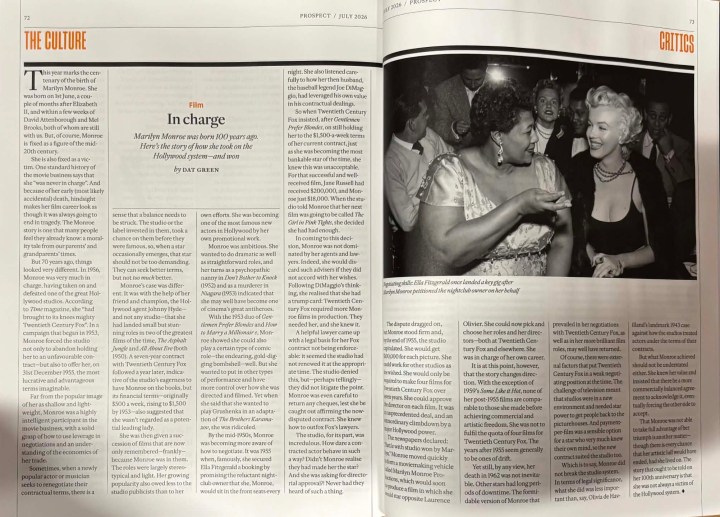
It’s an insightful piece, although some events have been condensed. For example, Green states that Marilyn was suspended by Fox after rejecting The Girl in Pink Tights. This occurred in early 1954, but Marilyn was able to resolve that issue by agreeing to star in There’s No Business Like Show Business.
It was later that year, after completing The Seven Year Itch, that Marilyn turned down another project and left Hollywood for New York. She was suspended once more, but whereas Pink Tights had been axed, How to Be Very Very Popular went ahead with Betty Grable and Sheree North (touted as ‘the new Monroe.’)
The success of The Seven Year Itch after its release in mid-1955 strengthened Marilyn’s case, but her renegotiated contract wasn’t a total victory. She had to concede her demand for script approval, one of several factors that would lead to her being fired from Something’s Got to Give in 1962.
Green reveals that his interest in Marilyn was sparked after he learned of her helping Ella Fitzgerald secure an engagement at a ‘segregationist’ nightclub. However, the club wasn’t racially segregated as has often been assumed, and Ella’s recollection of Marilyn attending her show ‘every night’ is incorrect.
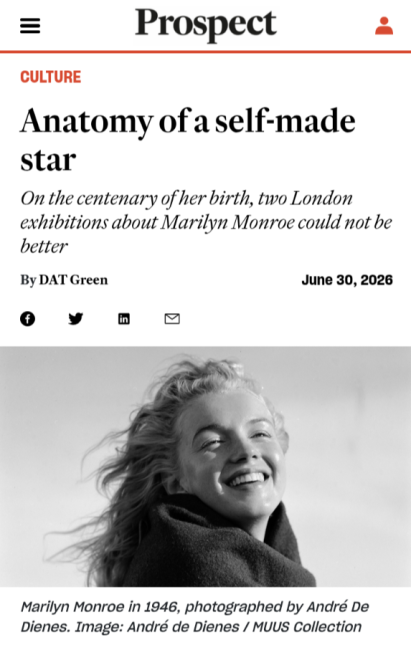
And finally, Green’s excellent review of London’s centennial tributes to Marilyn – headlined ‘Anatomy of a Self-Made Star‘ – was posted on the Prospect website yesterday. (Let’s hope it will also appear in the magazine’s August edition…)
“You could play it safe and choose the four great comedies: Gentlemen Prefer Blondes (1953), How to Marry a Millionaire (1953), The Seven Year Itch (1955) and Some Like It Hot (1959). It is this quartet that fixed the cultural icon of Monroe with which most people are familiar. She created an overwhelming construct, the comedic blonde bombshell, just as surely as Charlie Chaplin, Buster Keaton or Peter Sellers created any of theirs.
These four comedies are essential for any movie fan, especially in a cinema. All are perfectly shot and brilliantly directed and edited. But what Monroe brings to these films is impeccable comic timing and sheer on-screen dominance. She was already famous in the mid-1950s, but these films supercharged her popularity with the film-going public.
Yet those four are not actually that representative of Monroe. And one thing that the current, outstanding Marilyn Monroe: Self-Made Star season at the British Film Institute does well is to show a wider range of her films.
The BFI also make a point of showing Monroe in straight dramatic roles, before any of the big comedies were released. There is her stunning, if small, role opposite Bette Davis in All About Eve (1950) and her early thriller Don’t Bother to Knock (1952)—in this reviewer’s opinion, her best film—where she plays a psychopath babysitter. And there is her extraordinary breakthrough in Niagara (1953), where she steals the audience’s attention from the titular falls themselves, here being shown in full Technicolor, complete with rainbows.
That Monroe made it big not through comedy films but in more serious roles is significant. When her comedy persona became such a hit, there was an expectation that she should stick to it. Billy Wilder, her director in The Seven Year Itch, said she should just now exploit the character she had constructed … Though she could play the gold-digger, she did not monetise the gold-digger stereotype.
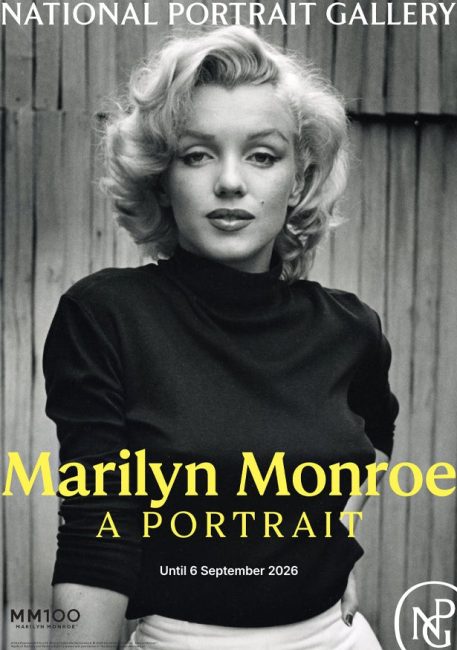
Another triumph is the companion exhibition at the National Portrait Gallery, as it was not only in front of the film camera that Monroe was a master of her art. This show is thorough and wonderfully curated, with the portraits being grouped as much as possible by photographer. Some of the hanging is astonishing: the presentation of the Blanket series by André de Dienes, for example, is breathtaking. And the careful contextualisation means that even old familiar pics can be looked at afresh.
One striking point about photographs of Monroe, even when many of them are placed together in one exhibition, is that no two photographs of her look the same. In an age of fixed smiles and stilted poses, the endless variation in this exhibition is a contrast to much of our Instagram culture. It is much an exhibition of portrait photography itself, as of its subject.
Both exhibitions remind us that Monroe came to stardom from outside the movie and celebrity system. She was a model with ambition who used opportunity and contacts to get her before the cameras, where her talent could do the rest. She paid for her own acting lessons with money she hardly had, and she listened to Ella Fitzgerald and others to help her learn to sing. She was an autodidact who made it. She worked with great directors and cinematographers and photographers, but the outputs were as much to her credit as to theirs.
And so it is fair to call her a genius of her craft. At that stage in the history of movies and also photography, it was perhaps the right time for someone to suddenly emerge with a special relationship with the lens and an intuitive understanding of what could be achieved. And Monroe did this largely by herself, with the help she could get. She was indeed, as the BFI rightly call their season, a self-made star.”

