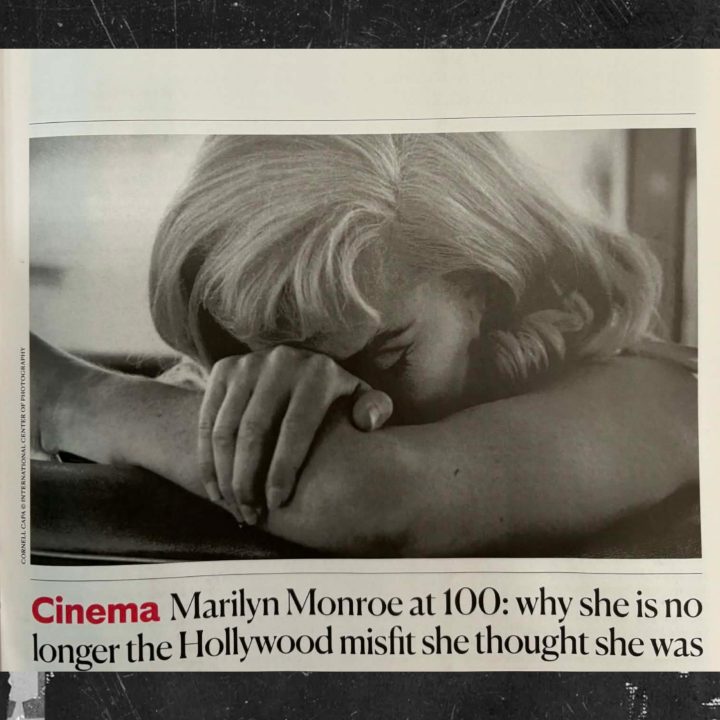
Writing for UK news weekly The New Statesman (June 26-July 2 edition), Ella Dorn argues that ‘Hollywood failed Marilyn Monroe.’ (In the Cornell Capa image shown above, Marilyn is shown preparing for a scene in The Misfits.)
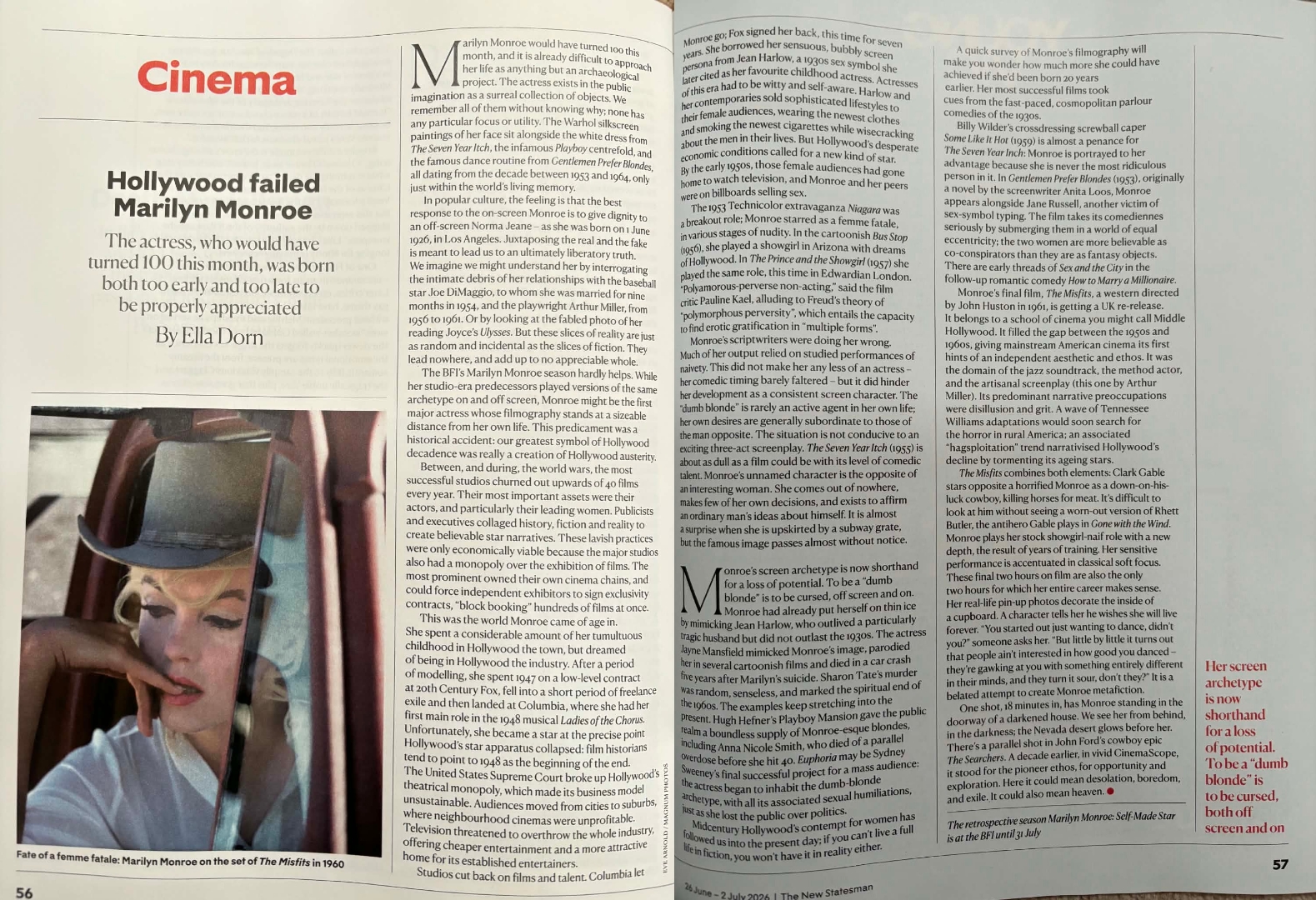
“Marilyn Monroe would have turned 100 this month, and it is already difficult to approach her life as anything but an archaeological project. The actress exists in the public imagination as a surreal collection of objects. We remember all of them without knowing why; none has any particular focus or utility. The Warhol silkscreen paintings of her face sit alongside the white dress from The Seven Year Itch, the infamous Playboy centrefold, and the famous dance routine from Gentlemen Prefer Blondes, all dating from the decade between 1953 and 1964, only just within the world’s living memory.
In popular culture, the feeling is that the best response to the on-screen Monroe is to give dignity to an off-screen Norma Jeane – as she was born on 1 June 1926, in Los Angeles. Juxtaposing the real and the fake is meant to lead us to an ultimately liberatory truth. We imagine we might understand her by interrogating the intimate debris of her relationships with the baseball star Joe DiMaggio, to whom she was married for nine months in 1954, and the playwright Arthur Miller, from 1956 to 1961. Or by looking at the fabled photo of her reading Joyce’s Ulysses. But these slices of reality are just as random and incidental as the slices of fiction. They lead nowhere, and add up to no appreciable whole.
The BFI’s Marilyn Monroe season hardly helps. While her studio-era predecessors played versions of the same archetype on and off screen, Monroe might be the first major actress whose filmography stands at a sizeable distance from her own life. This predicament was a historical accident: our greatest symbol of Hollywood decadence was really a creation of Hollywood austerity.
… Unfortunately, she became a star at the precise point Hollywood’s star apparatus collapsed … Audiences had gone home to watch television, and Monroe and her peers were on billboards selling sex.Much of her output relied on studied performances of naivety. This did not make her any less of an actress – her comedic timing barely faltered – but it did hinder her development as a consistent screen character. The ‘dumb blonde’ is rarely an active agent in her own life; her own desires are generally subordinate to those of the man opposite … Monroe’s screen archetype is now shorthand for a loss of potential. To be a ‘dumb blonde’ is to be cursed, off screen and on.
A quick survey of Monroe’s filmography will make you wonder how much more she could have achieved if she’d been born 20 years earlier. Her most successful films took cues from the fast-paced, cosmopolitan parlour comedies of the 1930s.
Billy Wilder’s crossdressing screwball caper Some Like It Hot (1959) is almost a penance for The Seven Year Itch: Monroe is portrayed to her advantage because she is never the most ridiculous person in it. In Gentlemen Prefer Blondes (1953), originally a novel by the screenwriter Anita Loos, Monroe appears alongside Jane Russell, another victim of sex-symbol typing. The film takes its comediennes seriously by submerging them in a world of equal eccentricity; the two women are more believable as co-conspirators than they are as fantasy objects. There are early threads of Sex and the City in the follow-up romantic comedy How to Marry a Millionaire.
Monroe’s final film, The Misfits, a western directed by John Huston in 1961, is getting a UK re-release. It belongs to a school of cinema you might call Middle Hollywood. It filled the gap between the 1950s and 1960s, giving mainstream American cinema its first hints of an independent aesthetic and ethos. It was the domain of the jazz soundtrack, the method actor, and the artisanal screenplay (this one by Arthur Miller). Its predominant narrative preoccupations were disillusion and grit … Monroe plays her stock showgirl-naif role with a new depth, the result of years of training. Her sensitive performance is accentuated in classical soft focus. These final two hours on film are also the only two hours for which her entire career makes sense.”
Thanks to Fraser

