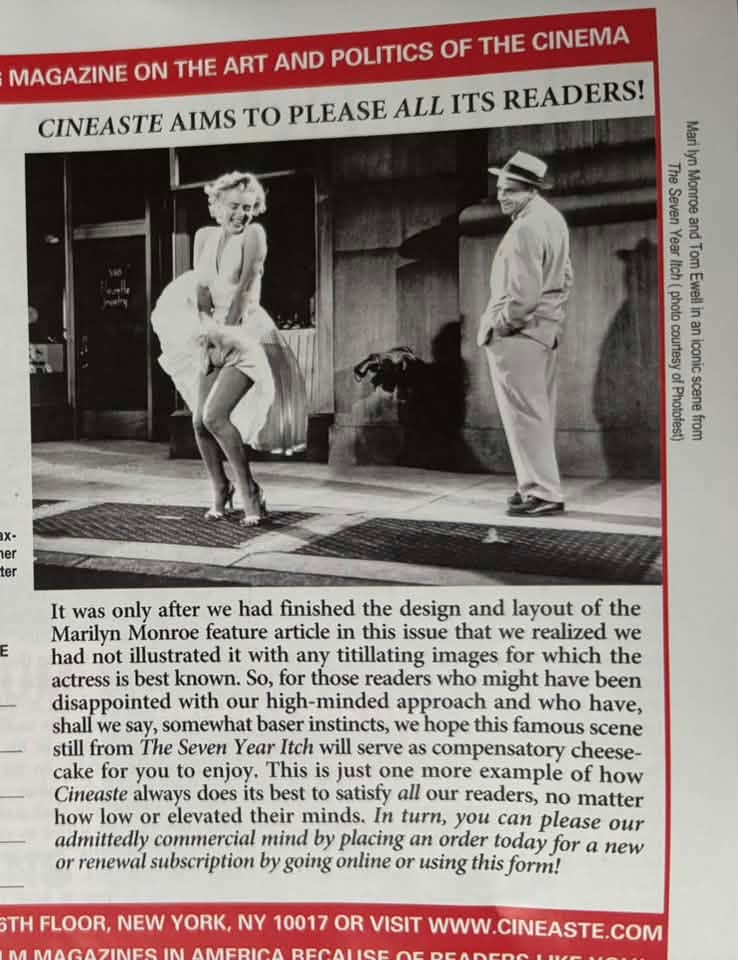
Marilyn graces the latest cover of US film journal Cineaste, with a colourised image showing her modelling the famous Moon of Baroda diamond for photographer Frank Powolny in 1953.
Inside, the film and literature scholar James Naremore looks beyond the glamorous facade. His essay, ‘Marilyn Monroe and the Art of Performance,’ was written for the Paris Cinémathèque exhibition, Marilyn Monroe: 100 Years.
“Many years ago, while researching at the Margaret Herrick Motion Picture Library in Los Angeles, I came across a handwritten note in the files on John Huston. ‘Dear John,’ it said. ‘Congratulations on The Asphalt Jungle. Where did you get that girl?’ It was signed, ‘Howard Hawks.’
The ‘girl,’ of course, was Marilyn Monroe, in a supporting role that helped to launch his career and led to a couple of films directed by Hawks … This year is the one-hundredth anniversary of Marilyn Monroe’s birth. She was both a star and a cultural phenomenon … In theatre, TV, painting, photography, and film, she has been represented almost as often as any historical personage …
Missing in all this, however, is a closer attention to her talent and the work she did in films – in other words, her art, which involved not only ability to create ‘her,’ in the sense of a star image, but also curiosity, intelligence, and a variety of performing skills. I want to concentrate on those things, and a good place to begin is with a detailed description of her acting in The Asphalt Jungle (1950.)”
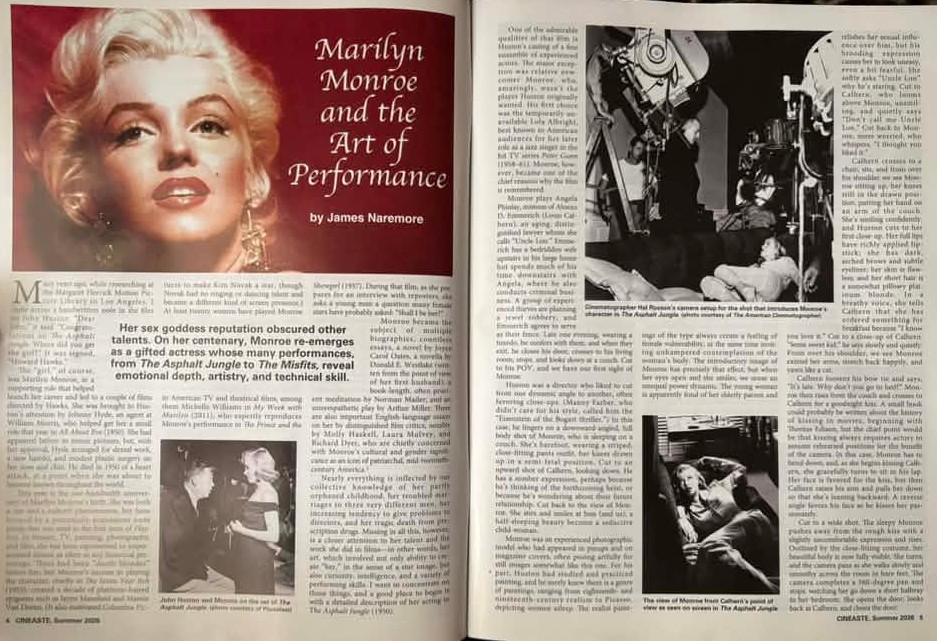
“Monroe was an experienced photographic model who had appeared in pinups and on magazine covers, posing artfully for still images … Huston had studied and practiced paintings, and he surely knew there is a genre of paintings, ranging from eighteenth- and nineteenth-century realism to Picasso, depicting women asleep. The realist paintings of the type always create a feeling of female vulnerability … The introductory image of Monroe has precisely that effect, but when her eyes open and she smiles, we sense an unequal power dynamic. The young woman is apparently fond of her elderly patron and relishes her sexual influence over him, but his brooding expression causes her to look uneasy, even a bit fearful. She softly asks ‘Uncle Lon’ why he’s staring. Cut to Calhern, who looms above Monroe, unsmiling …
Monroe had a good deal of dance and movement training and was among the surprisingly rare film or stage actors who could execute apparently simple things – crossing a room, sitting, rising, opening a door – in unostentatious but effective ways. There’s nothing showy or swivel-hipped about her walk in this scene, but it’s undeniably sexy. Cut to a close-up of Calhern, who has been observing her. ‘Some sweet kid,’ he says …
Monroe’s next scenes come after the heist has resulted in Calhern’s hired man being killed. She’s dressed for an evening out, wearing an off-the-shoulder black gown and a jewelled necklace … The doorbell rings and we hear a knock. Monroe sits up a bit and turns, looking toward the door. ‘Who is it this time of night?’ she asks. ‘Why are they pounding so hard? I’m scared.’ Anxiety or fear has seldom been far below the surface of her behaviour. She knows Calhern is involved in criminal activity … Calhern goes to the door and finds that plainclothes police and the Police Commissioner have come to arrest him. He suavely invites them toward the main room, where a fire is burning, and in the distance, we see Monroe running for cover.
The group gathers around the fireplace, and one of the cops is delegated to round up Monroe. He knocks at her bedroom door and warns that if she doesn’t answer he’ll break it in. Suddenly Monroe breaks open the door and confronts him. ‘Haven’t you bothered me enough, you big banana head!’ … But when he explains that the Police Commissioner wants to talk to her, she instantly changes her attitude … She’s a small woman (despite her screen presence, Monroe was petite) and now she’s surrounded by big men … As she’s led away, she reaches out and quietly says, ‘I’m sorry Uncle Lon, I tried.’ … ‘Don’t worry, baby,’ he says, reassuring her that she’ll have plenty of other opportunities.
Monroe certainly did. Any director would have been impressed by these scenes, not just because of her obvious sex appeal. Despite the relative brevity of the role, the performance is stunning. Besides demonstrating skill at movement and ability to create a character, it displays a greater range of emotional effects than any actor in the film: seductiveness, uncertainty, worry, childlike glee, fear, anger, guilt, and sorrow. One never has a sense that Monroe is pretending these emotions in an actorly fashion – like a Stanislavskian, she seems to feel them.”

“A versatile actor, Monroe had great comic timing, as one can see in Howard Hawks’ Gentlemen Prefer Blondes (1953) … She was also an accomplished, though not great, dancer and singer. In the Hawks film, Jane Russell seems to me the greater singer and Monroe the greater dancer … In Bus Stop (1956), an excellent mix of pathos and humour […] she imitates an Ozark accent and her rendition of ‘That Old Black Magic’ is sadly charming but deliberately amateurish, in keeping with the character she plays. Her most important attribute as a singer was always the ability to render emotion by ‘acting’ the lyrics, as in her touching performance of ‘I’m Through With Love’ in Some Like It Hot (1959.)
In the early 1950s, Monroe appeared in some dramatic rather than comic films. In Don’t Bother to Knock (1952), a generally forgettable picture, she played a psychologically disturbed babysitter; and in Niagara (1953), her chief job was to display her seductive body. The strongest early evidence of Monroe’s talent as a dramatic actor was her supporting role in Clash By Night (1952), an adaptation of a Clifford Odets play, directed by Fritz Lang […] who had a dictatorial attitude about postures, movements, and line readings. Things weren’t helped because since 1948 Monroe had worked with acting coach Natasha Lytess, whom she brought along … Lang complained vociferously but in the end, she is one of the best things in the film …”

“A much more complex dramatic performance is Monroe’s last complete film, The Misfits (1961), which, ironically, was directed by John Huston, a specialist in male action films who had helped jump-start her fame, and whose work in this picture served as a bookend to her career. It was a box-office failure and got mixed reviews. Some viewers today may regard it as too downbeat, but it has gained the respect it deserves … An aura of death surrounds the film … [Monroe’s] work nevertheless survives, and her performance has great intensity and variety …
At the beginning, Monroe’s character is in a daze of uncertainty and sadness … She sits at a mirror, carefully applying makeup while [Thelma] Ritter coaches her what to say during the impending divorce proceedings … Her opening scene is a good example of an expert actor doing one thing while talking about something else: in a hurry to be on time for court, she finishes her makeup and begins to dress while trying to remember her lines …
After the divorce, Monroe and Ritter go for a drink, where, in close-up, Monroe subtly conveys her emotion. Elbow on a table and chin in hand, she uses an object expressively – a napkin, which she picks up and drops listlessly to the table. She then softly touches her hair and mouth, lost in thought … She leans her forehead on her hand and looks down in near despair but then happens to look up and notices something across the room. ‘Oh, isn’t that the dearest dog,’ she says.
The dog, named Tom Dooley, belongs to [Clark] Gable, who is sitting at the bar with [Eli] Wallach, his back to Monroe. She entices Tom Dooley to come to her table by offering him food. Gable turns and finds the dog has gone. When he and Wallach spot Monroe, they cross to her table, beaming … The meeting with Tom Dooley also has thematic significance. Monroe’s love of animals will become a motif and lead to a crisis at the end …
Wallach has an unfinished house in the country, and, when he invites the two women to see it, Monroe’s mood lifts. She’s never been out of the city and likes the air … She’s also pleased with the house, at least until Wallach shows her the pristine bedroom he and his wife shared before she died. Above the bed is their wedding photo. A two-shot of Monroe and Wallach standing in the doorway and looking at the photo is one of Monroe’s most impressive moments … she seems to be trying to hide her strong feeling and stares almost blankly while Wallach calmly chatters …
Gable tells her she’s the saddest and most beautiful person he knows … They eventually move in together into Wallach’s incomplete house, and one morning Huston gives us another shot of Monroe asleep, quite different from the one in The Asphalt Jungle. The camera is at her level, looking at the top of her head, as she lies on her stomach with her mouth open. Gable approaches, bends down, and wakes her with a kiss … Conflict arises only when he wants to shoot rabbits who are eating the lettuce. Monroe fears for them and strongly resists. With a flash of anger, she grasps the gun he’s holding.
Things change again when Wallach and Ritter visit. Wallach is impressed with the household improvements and tells Gable that it’s a good time for ‘mustanging.’ Monroe doesn’t know what this means, but dresses up to accompany everyone back to Reno, where they find [Montgomery] Clift, a rodeo contestant who will help with the job. First, they all go to a crowded bar, where a drunken man bets Monroe ten dollars that she can’t hit a paddleball ten times without missing … A fight almost breaks out …
At the rodeo, Monroe’s loose-fitting designer dress and white stole stand out in the grandstand like a beacon, and so does her behaviour. She’s never been to a rodeo, and her tear-filled reactions range from shock to outright terror. She grips Wallach when the horses are tied with a tight strap around their midsection, and shouts, ‘It isn’t fair!’ When Clift is thrown twice and suffers a concussion, she panics, screaming … Later that evening, Gable gets dead drunk and Monroe nurses Clift …
The last act of the film is the capture of wild mustangs in the desert flats outside Reno. Impressively shot, it’s also Monroe’s most extreme encounter with cruelty to animals. Dressed in jeans, she stands aside throughout the action … but when the horses are thrown, roped and tied, she reacts with even more horror than at the rodeo … When the horses are subdued, Huston shows her standing alone in the arid distance, bending her knees and screaming with all her strength that the men are liars and killers.
Wallach, who throughout the film has been vaguely repellent, sits in the truck with Monroe and promises to save the horses if she comes away with him. Once again, the film frames the two actors side by side … She looks ahead almost inexpressively, then turns and straightforwardly, without gestures or histrionics, tells Wallach that he’s a self-pitying hypocrite …
The Misfits ends with Gable, Monroe, and Tom Dooley riding off in the truck, hoping to find a new way of life. The gesture toward happiness seems problematic … Whatever the case, The Misfits is an effective end to Monroe’s career – a film that puts her at the centre of the action and is at least partly about her … It’s a performance that required her to go to adult emotional depths, and it should have been crowned with an award.
Monroe’s career and stardom were in some ways unique. After her death, she became an icon of voluptuous beauty tormented by private insecurities and the pressures of Hollywood fame. As I’ve tried to argue, however, she is better remembered as a talented and versatile actor. It was primarily her work, skill, and intelligence that made her incandescent.”