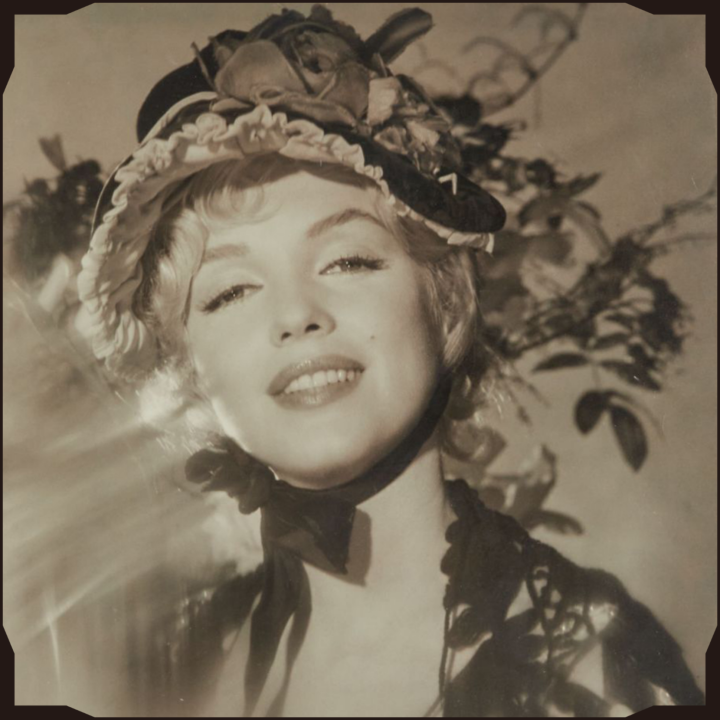
A number of Marilyn-related items from the Estate of Anna Strasberg will go under the hammer on Tuesday, August 4, in an online event at Julien’s Auctions. In a recent post, I highlighted lots which shed light on Marilyn’s relationship with the Strasberg family; and today, I’m looking more broadly at her life behind the spotlight.
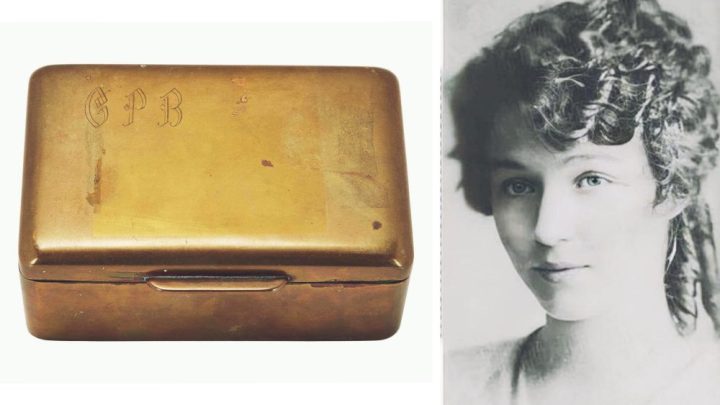
A brass trinket box engraved with the initials ‘GPB’, probably acquired by Marilyn’s mother Gladys Pearl Monroe during her first marriage to John Newton Baker (known as Jasper or ‘Jap’), from 1917-1921. After the couple divorced, Baker abducted their two children from Los Angeles and returned to his native Kentucky. Gladys’s third child was born Norma Jeane Mortenson in 1926, but was later called Baker so that her name would match her absent half-siblings.
SOLD for $6,400
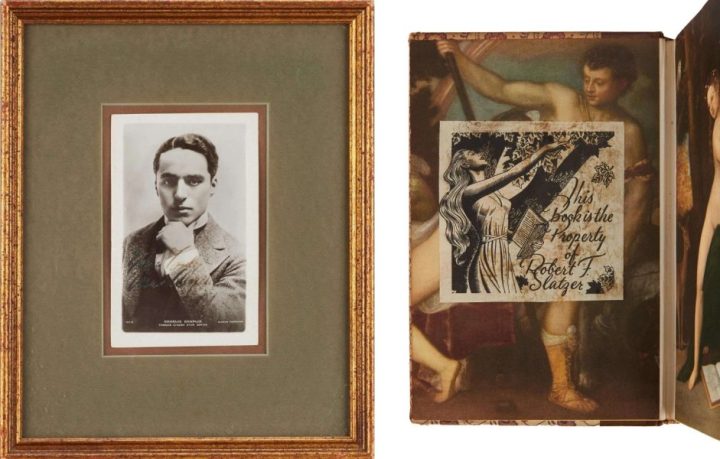
At left: a framed postcard featuring a 1920s photograph of the silent movie comedian and auteur Charlie Chaplin, signed ‘Yours Truly / Chas. Chaplin’. Marilyn befriended his son, Charlie Chaplin Jr., during the late 1940s. At right, two books gifted to Marilyn by journalist Robert Slatzer: Tales From the Arabian Nights, ed. P.H. Newby (1950); and Gods and Goddesses in Popular Legend. Both include personalised bookplates from Slatzer. As with Chaplin, it’s likely that Marilyn’s acquaintance with Slatzer ended long before her death, although he would later publish a notorious memoir.
Chaplin portrait SOLD for $2,880; books SOLD for $1,024
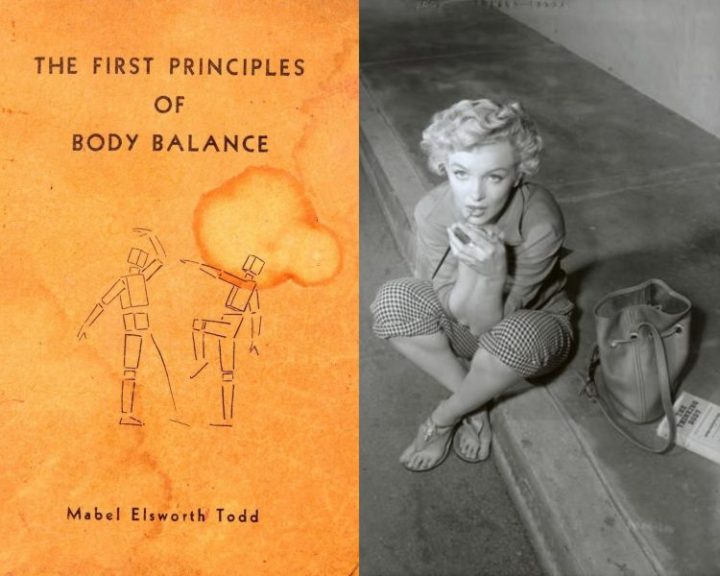
The First Principles of Body Balance, a 1934 pamphlet by Mabel Emsworth Todd. Marilyn was photographed on the set of Clash By Night (1952) with a copy of Todd’s 1937 book, The Thinking Body, and her early exercise routine was strongly influenced by the mind-body connection that Todd had developed.
SOLD for $4,480
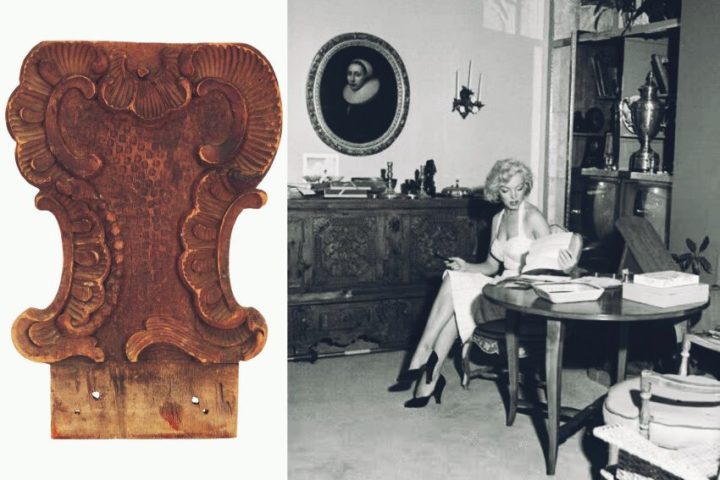
A small piece of ornately carved wood; seeming to be a trim that fell off the large sideboard/buffet that Marilyn had in her apartment at 882 North Doheny Drive in Los Angeles (though now it’s officially the City of West Hollywood); this piece of circa 1900s furniture can be seen in a number of photographs that Bob Beerman shot for Modern Screen magazine in 1953; evidently this small piece was important enough for Marilyn to save, though the whereabouts of the actual sideboard is now unknown.
SOLD for $2,240
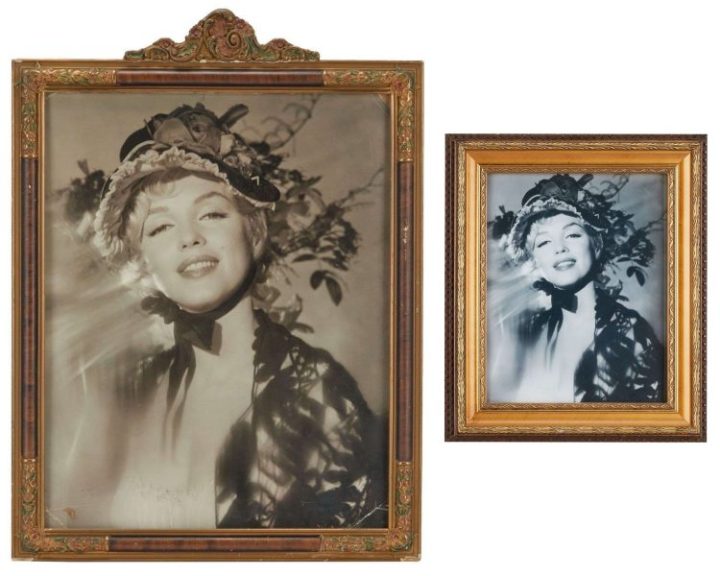
Two framed prints by Jack Cardiff, director of photography for The Prince and the Showgirl. The portrait was shot in England in 1956, as part of a ‘Renoir Girl’ series inspired by the French impressionist painter. The original, oversized sepia print was displayed for decades in the Strasbergs’ New York apartment; while the smaller bluetone print (circa 2000s) decorated a back bedroom.
Original oversized print SOLD for $2,240; smaller print SOLD for $768
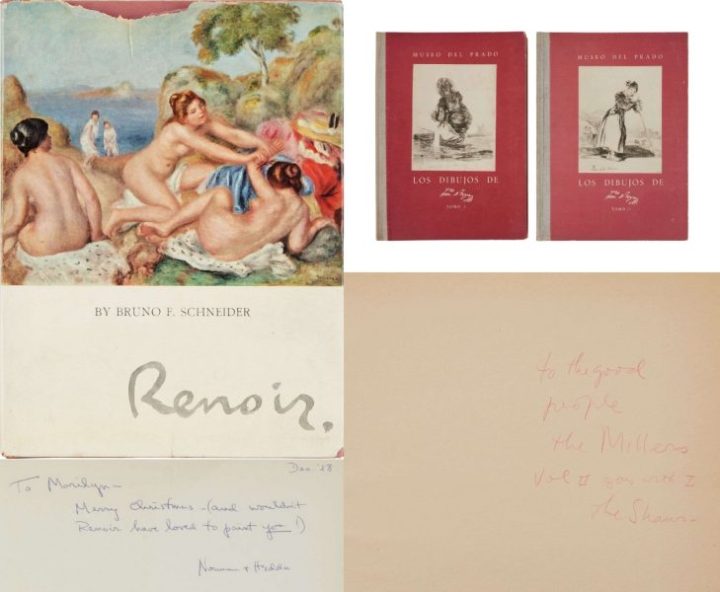
At left: Renoir by Bruno F. Schneider (Abrams, 1958), inscribed in blue ballpoint ink on the front free end page ‘Dec. ’58 / To Marilyn – Merry Christmas (and wouldn’t Renoir have loved to paint you!) / Norman & Hedda’ — the Rostens, a couple first known by Arthur Miller and then ‘adopted’ by Marilyn as her friends for the remainder of her life. At right: Los Dibujos de Goya by F.J. Sanchez Canton (Museo Del Prado, 1954), a two-volume set, housed in a red and black marbled paper slipcase, now broken due to age. The second volume is inscribed in red pencil by photographer Sam Shaw: ‘to the good people / the Millers / Vol II goes with I / the Shaws.’
Renoir book SOLD for $1,280; Goya book SOLD for $1,024
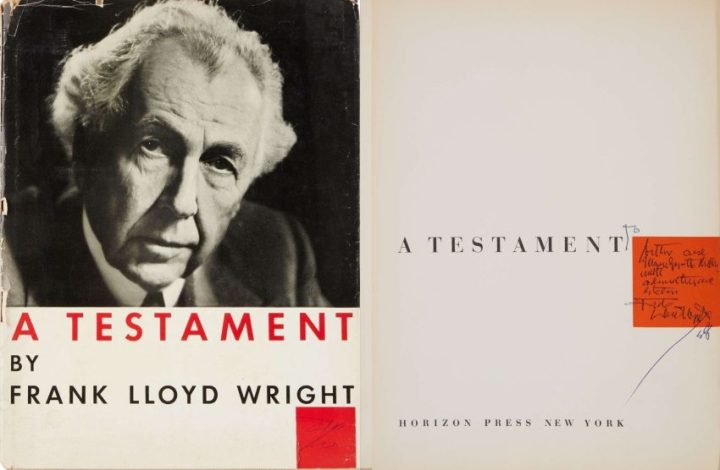
A Testament (1957), signed ‘To Arthur and Marilyn – the Millers / with admiration and esteem / Frank Lloyd Wright ’58.’ The architect was in talks with the Millers to design a new home on the site of their farmhouse in Roxbury, Connecticut. However, the plans were too costly and the couple decided to renovate the building instead. Frank Lloyd Wright, who died aged 91 in 1959, was the grandfather of actress Anne Baxter, who had starred alongside Marilyn in All About Eve (1950.)
SOLD for $6,400
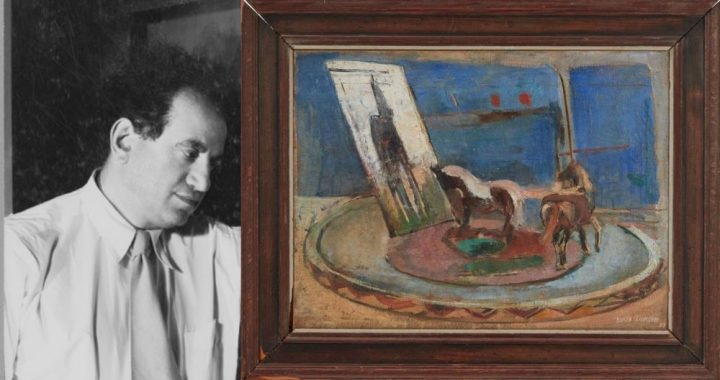
A 1939 oil painting by Boris Aronson, who designed the sets for the original Broadway production of Bus Stop, and several plays by Arthur Miller.
SOLD for $3,200
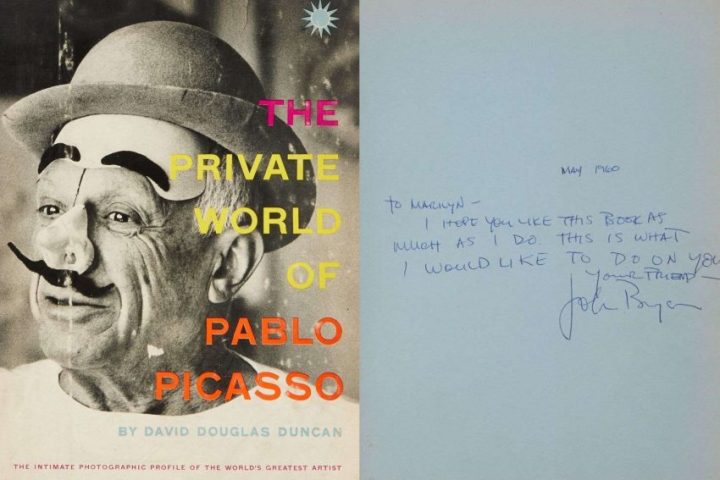
The Private World of Pablo Picasso (1958), a monograph on the legendary Spanish artist by photographer David Douglas Duncan. Signed in blue ballpoint ink on the front free-end page, ‘May 1960 / To Marilyn – I hope you like this book as much as I do. This is what I would like to do on you. / Your friend – John Boyce.’ While this project was never realised, in 1971 Boyce would publish a book of erotic drawings inspired by the writings of Anaïs Nin.
SOLD for $1,152
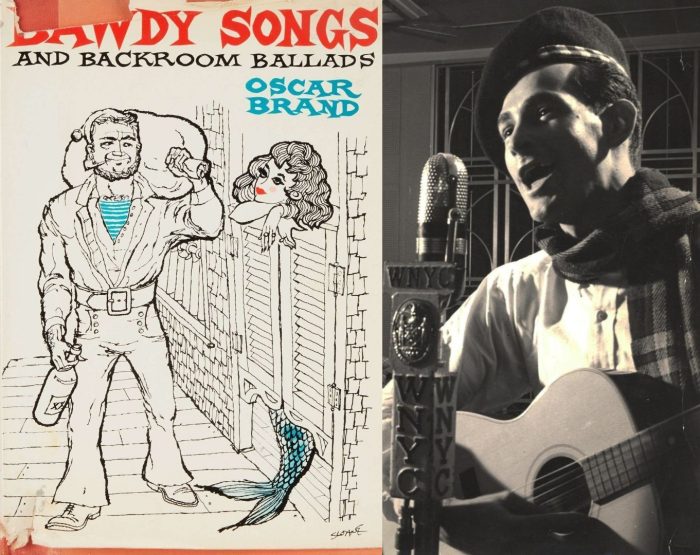
Bawdy Songs and Backroom Ballads (1960), a collection of traditional folk songs, inscribed ‘To Mr and Mrs Arthur Miller – with special respect and good wishes’ by Canadian-born singer-songwriter Oscar Brand, who hosted a weekly folk music show on WKNY radio in New York for 70 years.
SOLD for $1,152
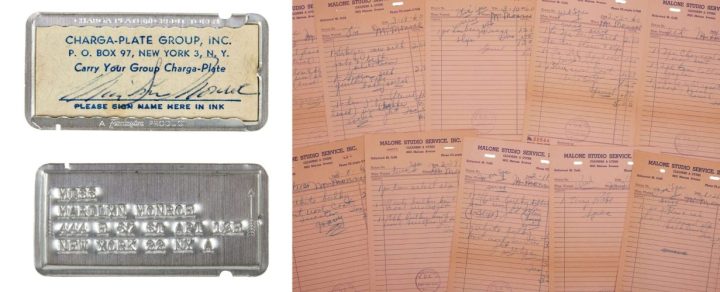
At left, a small Charga-Plate (circa 1950s) made of silver-tone metal and paper; embossed text reading ‘Miss Marilyn Monroe’ above her New York address on East 57th Street, with her tiny signature on the back. A precursor to credit cards, typically used by VIP clientele at department stores, restaurants and hotels. At right: a group of eleven dry-cleaning receipts from Malone Studio Service on Melrose Avenue in ‘Hollywood 46 Calif.,’ all noting the name ‘M. Monroe’ and ranging from January-March 1960, while Marilyn was filming Let’s Make Love. Each receipt notes the garments being cleaned, such as ‘terry robe’ and ‘white bulky knit wool coat/sweater.’
Charga-Plate SOLD for $11,520; receipts SOLD for $1,280
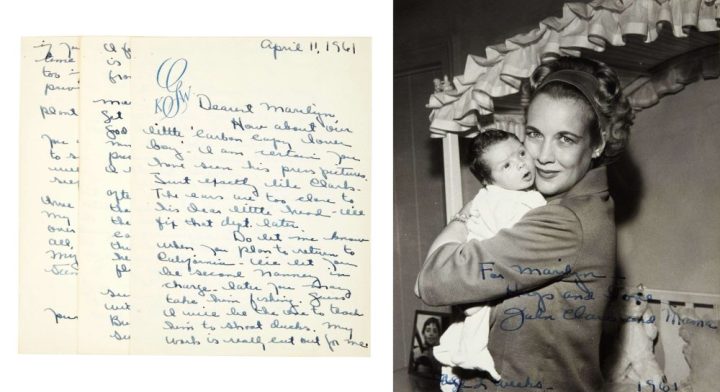
A three-page note from Kay Gable [Clark Gable’s widow and mother of his only son]; dated April 11, 1961, reading in part: ‘If you could spend some time with us bring Joe [DiMaggio] too if you wish very private at our happy home,’ ending with ‘Love Kay;’ also included is a black and white photograph of Kay with her newborn baby signed ‘For Marilyn – Hugs and love / John Clark and Mama / age 2 weeks / 1961’.
SOLD for $3,840
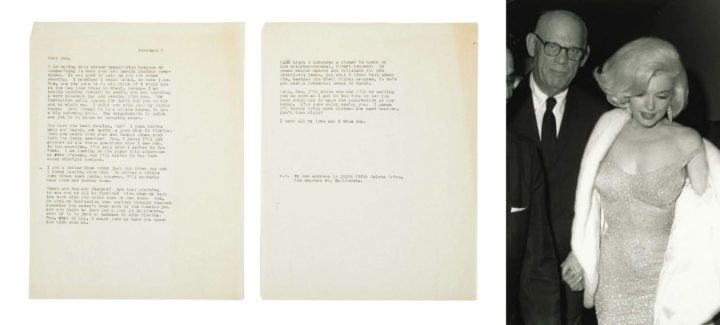
File copy of a letter from Marilyn to her ex-father-in-law, Isidore Miller, dated February 2, 1962. Marilyn invited ‘Dad’ to visit her at her new house on Fifth Helena Drive in Brentwood, Los Angeles; page two has some compelling content reading in part: ‘Last night I attended a dinner in honor of the Attorney-General Robert Kennedy. He seems rather mature and brilliant for his thirty-six years but what I liked best about him besides his Civil Rights program is he’s got such a wonderful sense of humor.’ She ends the letter with ‘I send all my love and I miss you …’
SOLD for $3,200
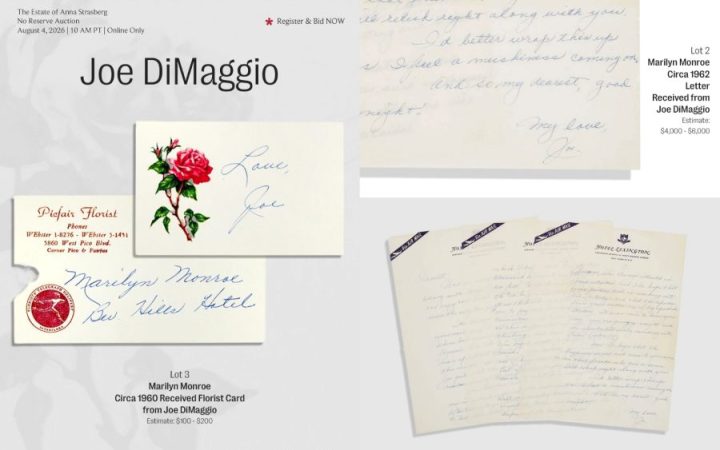
At left, an undated card (circa 1960) from Picfair Florist of Los Angeles, sent to Marilyn at the Beverly Hills Hotel, with the message ‘Love, Joe’ written in the florist’s hand. At right, a three-page undated note from Joe DiMaggio (circa 1962), written on Hotel Lexington letterhead (NYC), addressed to ‘Dearest.’ Regarding his troubled son Joe Jr., Joe writes: ‘You have been quite a help to me in so much as discussing Joe’s affairs. After talking to you today I called him to tell him what I planned to do which I did — sent him the two thousand dollars to pay for his car.’ Joe expresses concern about Marilyn’s ‘picture deal’ and with her health which suggests she was working on her last film, Something’s Got to Give. The letter ends with a somewhat cryptic sentiment: ‘Now I hope that the happiness we all seek comes to you soon so that friends who give a damn will relish right along with you,’ signing off with ‘My love Joe.’
Card SOLD for $4,480; letter SOLD for $8,960
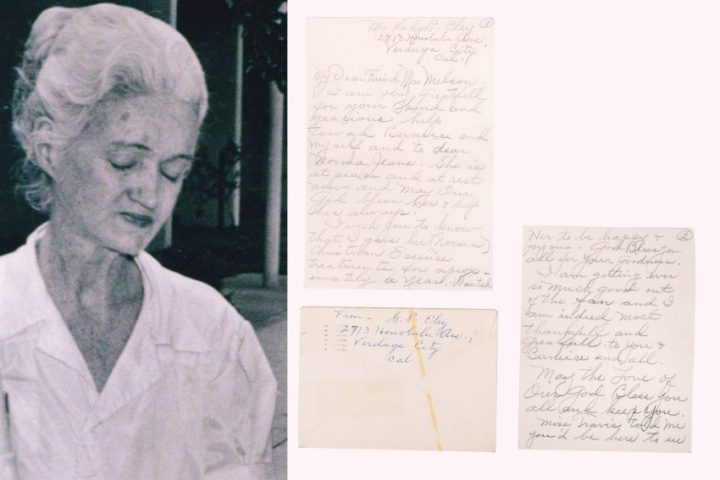
A short note from Marilyn’s mother Gladys to Inez Melson, Marilyn’s business manager and legal guardian to Gladys, dated August 22, 1962, regarding Marilyn’s death on August 4th. The letter reads in part: ‘Norma Jeane she is at peace and at rest now … I wish you to know that I gave her (Norma) Christrian [sic] Science treatments for approximately a year. Wanted her to be happy & joyous …’ The stationary is monogrammed ‘GE,’ denoting Gladys’s initials after her third marriage to John Stewart Eley, who died in 1952; and the original transmittal envelope shows that the letter was mailed from Verdugo City [now La Crescenta-Montrose CA], where Rockhaven Sanitarium, Gladys’s home for many years, was located.
SOLD for $3,520
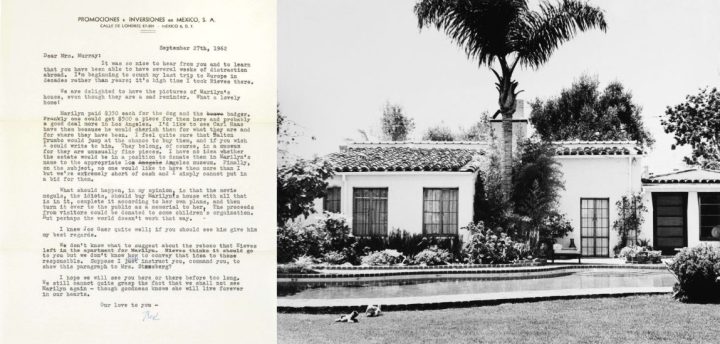
And last for now, two letters sent to Marilyn’s homecare assistant Eunice Murray at various addresses; the first is dated September 6, 1962, from Carl V. Haas Jr., reading in part ‘Fred Field and I have written each other …(we) feel that the Mexican objects (that Marilyn owned) shouldn’t go to just anyone … in the event they should come up for auction …would you please notify me?’ The second is dated September 27, 1962, from Fred Field [scion of the Vanderbilt family and a known leftist], reading in part: ‘What should happen is in my opinion is that the movie moguls, the idiots, should buy Marilyn’s house with all that is in it, complete it according to her own plans and then turn it over to the public as a memorial to her …’ Marilyn had visited both these men in Mexico in February 1962 while shopping for home furnishings with Mrs. Murray. Some 64 years after Field’s letter, the future of her last home is once again at stake.
SOLD for $512
 The Marilyn Report
1 Comment
Comments are closed.